


According to recent MIT research, an astonishing 95% of enterprise Generative AI pilots fail to deliver measurable ROI. Despite surging global investments in technical talent and infrastructure, the enterprise AI failure rate is climbing at an alarming pace.
The reason is rarely a lack of engineering capability. Instead, technical teams are falling into the trap of treating artificial intelligence like magic rather than a standard software component.
A lot of teams jump straight from an exciting idea to a two week sprint. The result is often an impressive technical prototype that works perfectly in a sandbox but falls apart when exposed to real users and real data.
This disconnect between expectation and reality is exactly why technical leaders need a structured framework to validate their ideas before writing a single line of code.
In this article, you will learn:
- Why the vast majority of AI pilots fail to reach production
- How to validate the true business value of an AI project
- The hidden data hygiene prerequisites for enterprise AI
- Why secure architectures matter more than model selection
The ROI Test: Stop Building AI for the Sake of AI
The best AI projects do not start with a fascination for the latest foundational model. They start with a clear, quantifiable business problem.
Consider the incredibly common example of an internal Developer Knowledge Assistant. The goal here is not simply to implement a large language model. The actual objective is solving a specific operational pain point, such as engineers wasting countless hours hunting down dependencies in outdated Confluence pages.
You need to define real AI project ROI before you spin up a development environment. If the proposed value cannot be explained to a CFO in under thirty seconds, the concept is not ready for a sprint.
Many organizations build technically impressive proofs of concept that fail to scale simply because they were never anchored to measurable outcomes like cycle time reduction. A successful AI operating model requires treating these projects as business investments first and technical experiments second.
Garbage In, Garbage Scaled: The Data Hygiene Prerequisite
The primary bottleneck for scaling an AI deployment is rarely the language model itself. It is almost always the underlying data infrastructure.
Technical teams usually do not need to train a custom model from scratch. Leveraging existing models combined with a solid enterprise RAG architecture is typically the most effective path forward.
However, Retrieval-Augmented Generation (RAG) relies entirely on the quality of the data it retrieves. If your internal documentation is messy, contradictory, or trapped in silos, the AI will simply scale that confusion faster. Recent industry surveys show that 85% of failed AI projects cite data quality or availability as a core issue.
Proper data hygiene for AI is a non-negotiable prerequisite. You cannot bypass the hard work of restructuring your data by throwing a smarter algorithm at it. In fact, simply improving data structure and metadata taxonomy can raise chatbot accuracy from 60% to 90% without changing the underlying language model at all.
Before committing to a massive build, run a simple experiment with a public model. If it cannot answer basic queries correctly using a sample of your current documentation, you must fix your data structure first.

Build for Reality: Secure Architectures and Governance
Transitioning an AI model from a controlled sandbox to a live production environment introduces severe security risks. Even the most capable model will not survive poor integration.
You are now dealing with real user data and real organizational consequences. This shift requires strict agentic AI governance and clear access controls. For example, an intern should never be able to prompt an internal AI assistant into revealing infrastructure keys or payroll data.
Security teams must treat LLM prompt injection risks as serious, top tier incidents rather than theoretical edge cases. The Open Worldwide Application Security Project currently ranks prompt injection as the absolute top vulnerability for these applications. Attackers can easily embed malicious commands within seemingly innocent user inputs or external documents.
Furthermore, enterprises often fall victim to privacy theater when deploying these tools. There is a rise in wrapper solutions that deploy a local interface but covertly route the actual inference requests to public API endpoints. This immediately breaks the data residency chain of custody, exposing proprietary context to external servers.
Deploying overly restrictive internal tools without proper usability can also backfire. If an internal system is too locked down to be useful, frustrated employees will inevitably turn to unauthorized public tools. This creates massive shadow AI risks, where proprietary source code or customer data is leaked into external training models.
If an AI system has the permission to access the wrong document, it has the ability to leak the wrong document. Production workflows must assume the model will occasionally fail and must be designed to fail safely.
The AI Readiness Diagnostic
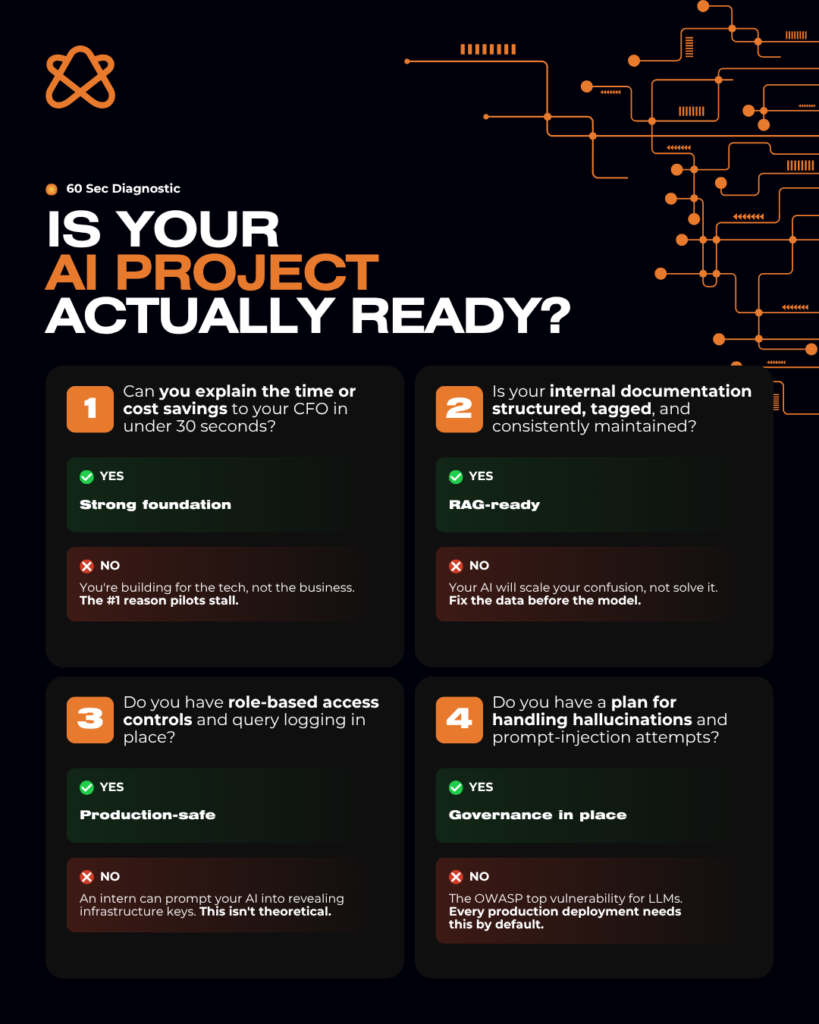
Before authorizing your next AI initiative, ask yourself these diagnostic questions:
- Can we quantify the exact time or operational cost this AI tool will save?
- Is the underlying data structured, clean, and ready for retrieval?
- Are we actively logging AI queries and restricting data access based on user roles?
- Do we have a robust plan for handling inaccurate responses or prompt injection attempts?
Stop Innovating, Start Engineering
The AI Reality Check is the fundamental difference between a flashy demo that impresses a boardroom and a robust product that actually ships.
Building successful AI applications requires abandoning the novelty mindset. Stop asking which model your team should use. Start asking if the product deserves to exist, if it can actually work with your current data, and if it can run safely in a production environment.
👉 Diagnosis is only the first step. Follow for Part Two, where we’ll shift from what to avoid to exactly what you should build.