


The Challenge
When Envision AI Labs was conceptualised, the engineering ambition expanded overnight. Envision AI Labs’ product scope was growing, from FieldFocus and MarketSphere into a broader suite covering medical, commercial, market access, and real-world evidence, and each new product area meant more squads, more capability, more headcount needed now rather than later.
The problem wasn’t ambition. It was geography and specialisation.
Building AI for pharmaceutical companies is not a standard engineering challenge. Envision AI Labs’ stack spans modern full-stack web development, AI and machine learning pipelines, data engineering, and quality assurance, all within the regulatory and data-sensitivity context of life sciences. That combination is rare anywhere. In Cambridge and the Netherlands, Envision AI Labs’ two closest hiring markets, it was effectively impossible to assemble at speed without paying a significant premium and waiting three to six months per senior role.
Hiring locally, squad by squad, was not a viable plan for three interconnected reasons.
The talent pool was thin. The overlap between strong AI/ML capability and life-sciences domain understanding is narrow in Europe. Cambridge and Amsterdam are two of the most competitive tech markets on the continent: senior engineers are expensive, cautious about moving, and in consistent demand from well-funded competitors. Even with the right compensation, hiring timelines stretched to half a year per role.
The team structure was complex. Envision AI Labs didn’t need one type of engineer; it needed several, simultaneously. Full-stack developers, AI and GenAI engineers, data engineers, QA automation specialists across multiple concurrent product squads, not a single centralised unit. That kind of multi-disciplinary, multi-squad build requires both volume and precision, and it needs to move in parallel, not in sequence.
And compliance wasn’t optional. Envision AI Labs builds AI products for pharmaceutical clients who operate under strict data governance requirements. Any engineering team – regardless of where they sat – needed to work inside Envision AI Labs’ security standards from the first day of engagement. A compliance retrofit six months in wasn’t a risk the business could take.
The gap between where the engineering organisation needed to be and what the local market could practically deliver was significant. Something had to change.
The Solution
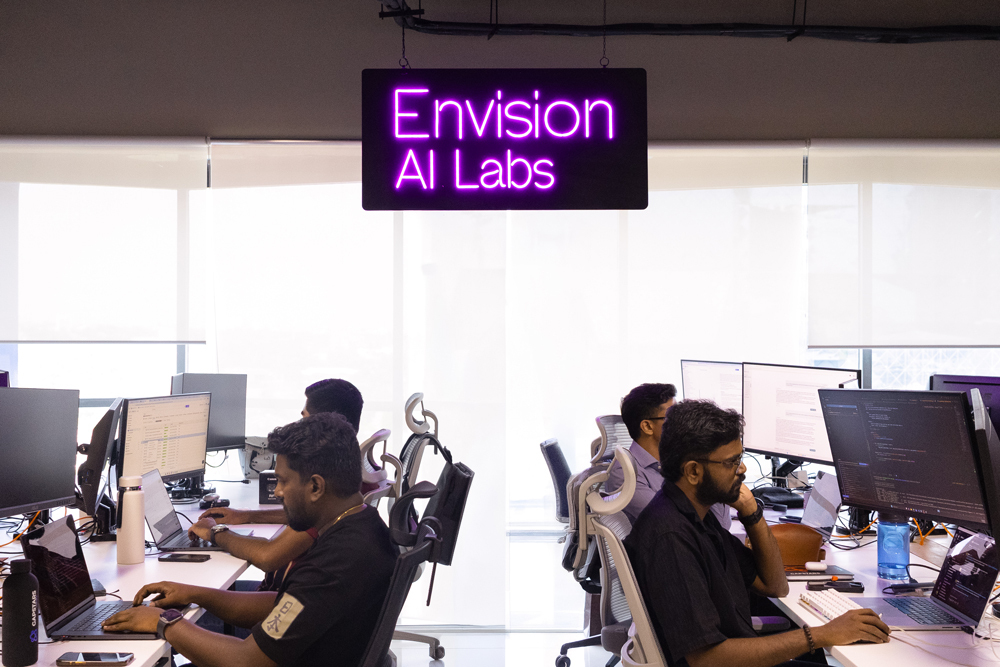
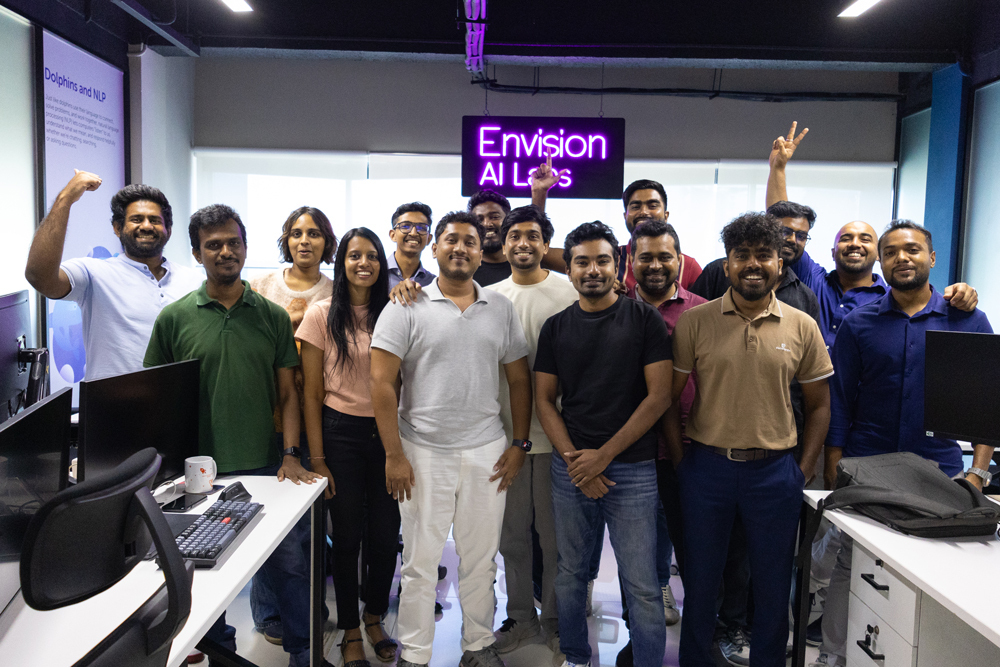
Gapstars built Envision AI Labs’ embedded engineering organisation in Sri Lanka, not as a generic offshore pool, but as a purpose-built structure mirroring Envision AI Labs’ own product areas and capability needs.
The starting point was intentional design. Rather than filling headcount as fast as possible, Gapstars worked to understand how Envision AI Labs’ squads were structured, what each squad was building, and what combination of skills each one needed to function effectively. The result was a team built around four capability areas: software engineering, AI and GenAI engineering, data engineering, and QA automation each mapped to a specific product context.
Nine engineers are embedded today. Six more are joining. At full strength, the team will be eighteen, all background-checked on hire, all operating under signed NDAs, and all working inside Envision AI Labs’ own tooling, standards, and processes from the first sprint.
Three things differentiated the Gapstars approach from conventional alternatives.
Specialist matching at pace. Gapstars sourced across AI/ML, full-stack, data engineering, and QA simultaneously — reaching into a talent market that Cambridge and Amsterdam couldn’t access quickly enough, and screening for the precise combination of technical depth and adaptability that life-sciences product work demands. The result was a multi-disciplinary team assembled in a fraction of the time it would have taken through local hiring.
True squad embedding. Envision AI Labs’ Gapstars engineers don’t sit adjacent to the product team — they sit inside it. Same sprints, same standups, same product managers and colleagues. There is no separate offshore unit managing its own backlog, no handover process, no communication overhead that comes from treating the extended team as a vendor. The engineers are, in every practical sense, part of Envision AI Labs.
Operational infrastructure that disappears into the background. Gapstars handles hiring, onboarding, payroll, HR, and facilities — so Envision AI Labs’ leadership gets a high-performing team without the overhead of running an entity in a new market. ISO 27001-certified infrastructure, fully GDPR-aligned, with every practitioner cleared and compliant before the work begins.
Impact & Results
Building equivalent capability through local hiring would have meant competing for a thin pool of AI and life-sciences engineers in one of Europe’s most expensive tech markets – at three to six months per senior role, with no guarantee of retention once hired. A 15-person multi-disciplinary build through that model would have taken the better part of two years and cost materially more before a single sprint was delivered.
Through Gapstars, Envision built a stable, multi-squad engineering organisation at a cost structure that allowed the savings to be reinvested directly into product development and platform expansion.
Accelerated product delivery. The Sri Lanka team contributes across the full delivery lifecycle – system architecture, backend and frontend development, database design, deployment, and ongoing platform enhancement. The squads don’t wait for direction from Cambridge; they own their areas and ship. Envision AI Labs moves faster because the team is built to move with it.
Stronger AI-generated insight. Engineers have built and maintained solutions that help medical and scientific teams extract meaning from large, unstructured content sets – field reports, publications, advisory board materials, clinical transcripts. The output is faster trend identification, sentiment analysis, evidence-gap detection, and context-grounded querying across complex scientific datasets.
Reduced manual effort in complex workflows. By supporting the automation of content-heavy medical and scientific processes, the team has improved engineering scalability and end-user productivity – enabling Envision’s platforms to process complex materials more efficiently and convert unstructured content into structured, actionable outputs.
Platform reliability at production scale. The team maintains what it ships. Bug fixes, performance improvements, data refresh, and orchestration work run continuously – keeping Envision AI Labs’ platforms stable and ready for the reliability expectations of top-tier pharmaceutical clients.
Compliance infrastructure that holds up under scrutiny. Several platforms operate in compliance-sensitive environments where accuracy, traceability, and governance are non-negotiable. The team’s work across document processing, metadata extraction, approval workflows, and auditability has built the underlying infrastructure that makes AI defensible in life sciences – not just functional.
Looking Ahead
Six more engineers are joining the Sri Lanka team, adding GenAI engineering, QA automation, project management, and technical leadership to existing capability. As Envision continues to expand Envision AI Labs’ AI mandate across the pharmaceutical industry, the engineering organisation is built to keep pace not catch up.
The model scales because the fundamentals are right. Engineers who are embedded, not contracted. Teams that own their platforms rather than complete their tickets. An operational structure that lets Envision AI Labs focus on the product while Gapstars handles everything behind it.
The partnership has proven that building specialist engineering capacity for a regulated, fast-moving AI product doesn’t require compromising on talent, depth, or standards. It requires the right model and the right partner to run it.
Download the full case study now
Discover how Beequip scaled beyond Rotterdam to build a high-performing international engineering team in Lisbon, fully embedded into their product and company culture with Gapstars.